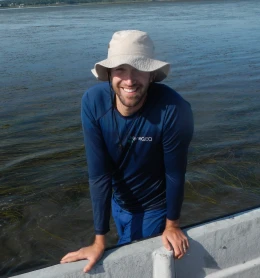
 Jon Lefcheck

I’m currently a Research Scientist at the University of Maryland Center for Environmental Science. I was formerly the Tennenbaum Coordinating Scientist for the Smithsonian Institution’s MarineGEO program, and a post-doctoral researcher at Bigelow Laboratory for Ocean Sciences in East Boothbay, ME and at the Virginia Institute of Marine Science in Gloucester Point, VA. I received my Ph.D. in Marine Science from The College of William & Mary in 2015.
My interests span from community and applied ecology, biodiversity science, ecological statistics, and conservation and restoration. I test and employ ecological theory to inform nature-based solutions to mitigate response to climate change and other anthropogenic impacts. I have worked in a variety of ecosystems, from marine to terrestrial, but have an enduring affinity for seagrasses and other underwater vegetation. I also am increasingly interested in the role of coastal systems, such as seagrasses and mangroves, in providing “blue solutions,” for example, as sinks of “blue carbon” and sources of “blue foods.”
To help with my research, I develop new statistical methods and approaches, principally structural equation modeling (SEM). I write and maintain an R package to conduct SEM and teach international courses on the applications of this method. You can read more about SEM in all its forms in my online book.
My prior post-doctoral work involved understanding the patterns and drivers of submerged aquatic vegetation in the Chesapeake Bay over the past 30 years, and the factors that drive herbivory on Caribbean coral reefs. My Ph.D. research focused on the application of organismal ‘functional traits’ to both experiments and observational surveys to demonstrate how knowing what an organisms does–rather than what it is called–may help us better describe and predict the consequences of changing biodiversity.
I started the blog sample(ECOLOGY) to share some of the thoughts, explorations, and R code that I stash away on a daily basis. Hopefully someone out there will find some use for it as well. (Even though I haven’t added a post in years!)
Also, follow me on Twitter!
Follow @jslefche sample(ECOLOGY)
Ciao from a Mediterranean time series station in Italy!
Nice to see a fellow blogger, ecologist and R-user!
Dear Jon,
Where is your latest updated code/function of the rsquared.lme? I coundn’t access
https://github.com/jslefche/rsquared.glmer/%5D .
Can you tell me where it is, or could you please send me in an email?
Also, do you have founction/code for backward model selection for lmer?
Hi Clara, Whoops, looks like there was some gibberish at the end of the link. Try: https://github.com/jslefche/rsquared.glmer/
As for model selection, try the function ‘dredge’ in the AICcmodavg package. I’m pretty sure it has support for lmer. Cheers, Jon
Dear Jon,
I have learned so much from your papers about SEM. But when I want to download your teaching materials in this page: https://jonlefcheck.net/teaching/, it always comes an error.
So could you sent me a copy of these materials? I’ll appreciate it soooo much!
My email: wangpd@mail2.sysu.edu.cn
Hi Pandeng, hang tight, I will be updating those shortly. If it still doesn’t work, please send me an email! Cheers, Jon
Thank you so much…I learnt a lot from your sharing especially on R programming..:-)